
NAFTH – The breath, the word, the protection
«Yogaś citta-vṛtti-nirodhaḥ»
«Lo yoga è la quiete delle fluttuazioni della mente.»
— Patañjali, Yoga Sutra, I.2
«Verily, in the remembrance of Allah do hearts find rest.»
— Corano, Ar-Ra’d, 13:28
The gesture of Islamic tradition between the Quran, breath, yoga, and neuroscience
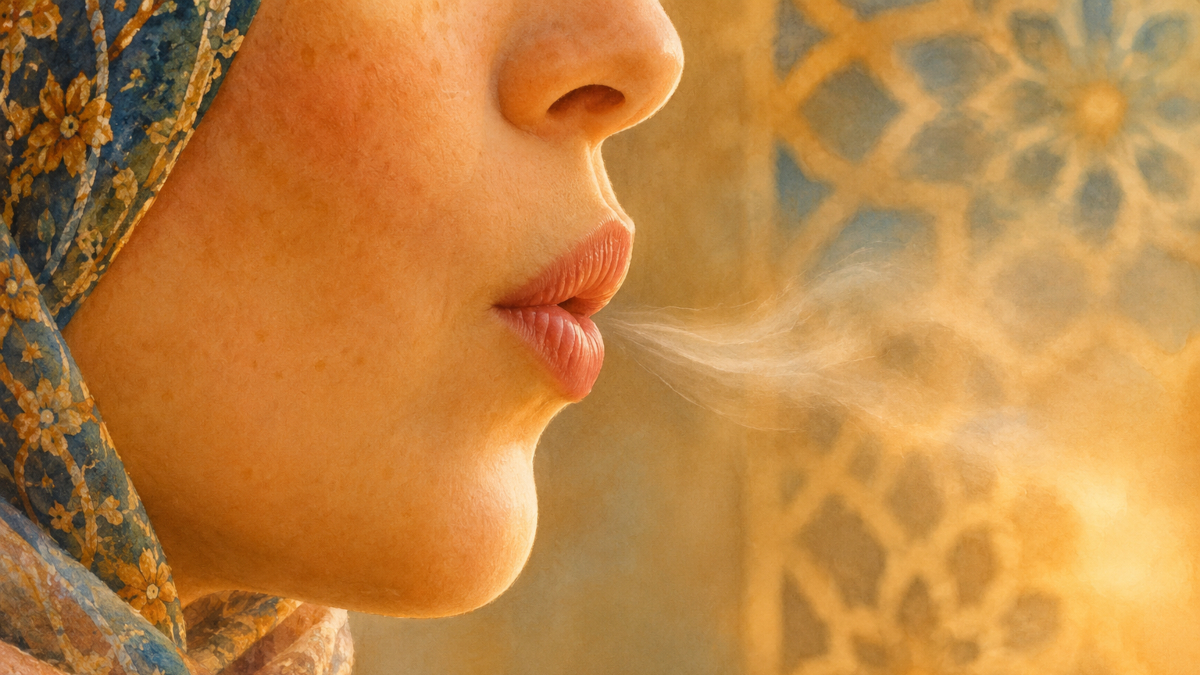
A light breath, similar to the one we blow to cool a spoonful of soup. A delicate exhalation through softly parted lips, which in Islamic tradition accompanies the recitation of Quranic verses: Nafth.
It is a simple gesture, yet rich in meaning. In the prophetic Islamic tradition, the breath accompanies certain practices of protection and spiritual care, in which the Quranic word, the breath, and the intention come together in a single ritual. It is not merely about uttering a prayer: the recitation extends into a gesture directed toward the body, as if the word were seeking a form through which to embody itself.
Nafth thus invites us to pause upon an ancient and profound relationship: that between word and breath. The voice originates from the breath, modulating and shaping it; the breath, in turn, makes perceptible something that usually remains invisible. In practice, the exhalation is gentle, produced through softly parted lips. This method may recall, in certain aspects, the controlled exhalation breathing techniques studied in contemporary research.
Neuroscience and the physiology of breath have indeed shown that the rhythm, duration, and method of exhalation can influence the activity of the autonomic nervous system and specific cardiovascular parameters. Pursed-lip breathing, in particular, has been studied for its role in modulating exhalation, exerting a calming effect on the entire nervous system. We do not yet know whether or to what extent these findings can be directly applied to nafth, which does not correspond to a structured breathing technique and has not been studied as an independent practice. However, it offers a potential framework for understanding—allowing us to examine the gesture in its physical dimension without reducing its spiritual meaning to a mere physiological effect.
To better understand this practice, we must start from its origin: the teachings and gestures of the Prophet Muhammad, where nafth appears during moments associated with prayer, protection, and healing.
A gesture in the tradition of the Prophet
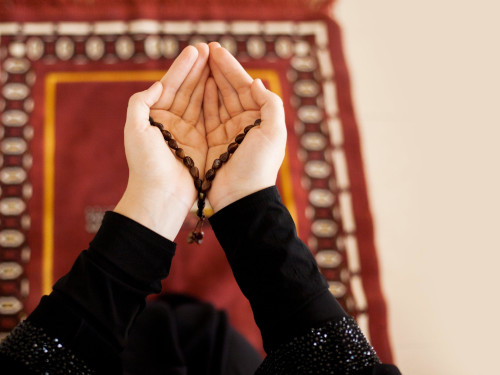
One of the most widely known accounts of Nafth is found in a Hadith narrated by ʿAʾisha and recorded by al-Bukhari. Every evening before going to sleep, the Prophet Muhammad would join his hands together, blow gently onto his palms after reciting the last three Surahs of the Quran—Al-Ikhlas, Al-Falaq, and An-Nas—and then pass his hands over his body, touching as much of it as he could reach. He would repeat this gesture three times.
It is an essential, almost intimate scene: the end of the day, quiet reflection, the recitation, the breath onto the hands, and the touch upon one’s own body. The spoken word does not remain suspended in the air; it is accompanied by a gesture and brought back to the concrete dimension of the person.
This account is particularly interesting because it shows how, in the Prophet’s practice, Quranic recitation and nafth were not separate elements. The word was uttered, the breath accompanied it, and the hands symbolically brought it into contact with the body.
Another account, also transmitted by ʿAʾisha and reported by al-Bukhari, relates that during the illness preceding his death, the Prophet would recite the Surahs of protection and blow over his own body. When his condition worsened, it was ʿAʾisha who recited and performed the gesture for him, guiding his hands across his body.
The practice also appears in a different context. In a Hadith recorded by al-Bukhari, some companions of the Prophet, while traveling, encountered a man bitten by a venomous animal. One of them recited Surah Al-Fatiha and accompanied the recitation with a breath over the affected area. The man recovered, and when the Prophet was informed of what had happened, he approved of the companion’s action.
Finally, in a Hadith from Sahih Muslim, the Prophet teaches how to act after a bad dream: to seek refuge in Allah through the phrase A’udhu billahi min ash-shaytan ir-rajim (which translates to “I seek refuge in Allah from Satan the outcast“—an invocation carrying the deep spiritual meaning of humbly relying on divine protection to purify the mind from negative thoughts and find immediate inner peace), to blow three times over one’s left shoulder, and to turn to the other side to sleep.
These accounts reveal a practice present in multiple circumstances: preparing for rest, facing illness, seeking protection, and within the context of ruqya—the recitation of Quranic words and invocations for spiritual healing. Nafth, however, is not a gesture to be considered in isolation: its significance lies in its relationship with the recited word, with intention, and, above all, with surrender and devotion to the Divine.
An interesting extension of this practice can be found in the Islamic tradition of ruqya: the recitation of Qur’anic verses over water, accompanied by a gentle breath, after which the water is drunk or used to wash the body. This particular practice is not described as explicitly in the Prophetic narrations concerning nafth into the hands, but it has been considered permissible by several Muslim scholars and finds precedents in practices attributed to some of the early authorities of the tradition, including Imam Ahmad.
It is fascinating to consider how contemporary this intuition within the Islamic tradition feels: entrusting water with a recited word, accompanied by breath and intention. It invites us to reflect on the subtle relationship between sound, matter and life. Our bodies are largely composed of water and are continuously permeated by rhythms, impulses, oscillations and vibrations. The spoken word, through voice and breath, also enters this universe of resonance, reaching not only our capacity for understanding, but also our sensory and emotional dimensions.
From the perspective of Islamic spirituality, Qur’anic recitation is much more than the transmission of meaning. It is a sonic and vibrational experience: the revealed Word takes form through rhythm, the articulation of letters, pauses, breath and the resonance of the voice. The Qur’an, in its original form, is the revealed Word in Arabic; translations can help us approach its meaning, but cannot fully convey its phonetic qualities or sonic dimension. Recitation thus becomes an experience that engages listening, the body and the inner self: the Word is spoken, heard and, in a sense, inhabited.
The breath, the body, and the word
What happens when such a simple gesture simultaneously engages breath, voice, attention, and touch?
We can approach this question through a dialogue with other contemplative traditions, without confusing their origins. In yoga, for example, the breath has always been a pathway for exploring the relationship between body and consciousness. Pranayama, described by Patañjali in the Yoga Sutras, concerns the regulation and expansion of the breath and constitutes a specific dimension of the yogic path.

Nafth is neither pranayama nor a breathing exercise in the technical sense of the term. It does not necessarily involve a specific rhythm, duration, or sequence of breath control. And yet, between these gestures, we can recognize a common ground for dialogue: the breath is not merely a physiological process, but can become an opportunity to gather attention and bring greater awareness to one’s relationship with the present moment.
Scientific research has focused primarily on the effects of slow, voluntary, and controlled breathing. Several literature reviews have observed associations between these practices and shifts in certain indices of autonomic activity, including heart rate variability. Some findings suggest the involvement of mechanisms linked to parasympathetic and vagal regulation.
Recitation requires attention to the word and focused intention; the breath introduces a conscious exhalation; the movement of the hands and contact with the body add a sensory dimension. Together, these elements can help shape a moment of quiet reflection and deep stillness.
The body, from this perspective, is not a simple recipient of a mental intention. It participates in the gesture. The voice moves through the breath, the breath accompanies the word, and the hands bring attention back to physical presence. It is an experience in which meaning is not only thought, but also spoken and embodied.
Perhaps this is precisely where the gesture becomes compelling: not because we can translate it into a technique of self-regulation, but because it reminds us how deeply the spiritual dimension involves the body and the lived physical experience.
The three Surahs: centering the self, protecting boundaries, freeing the mind
The last three Surahs of the Quran, Al-Ikhlas, Al-Falaq, and An-Nas, are recited together in the prophetic practice of nafth. In the Islamic tradition, they are Surahs of protection, but we can also allow their meanings to guide us through a journey of inward reflection—one that moves from the recognition of Divine Unity, to protection from what threatens us, to seeking refuge from the mental fluctuations that disturb our inner peace.
It is possible to discern in this sequence a kind of geography of the human experience: first finding a center, then learning to guard one’s boundaries, and finally observing with greater clarity what occurs within the mind. This is not about reducing the Quranic message to a psychological practice, nor about attributing meanings foreign to their origins to the Surahs. Rather, it is about exploring certain resonances, allowing the wisdom of an ancient spiritual tradition to enter into dialogue with our lived experience.
The translations and reflections that follow are intended as approaches to the text and interpretative starting points, rather than as exhaustive renderings of the Qur’anic Word. Every word of the Qur’an holds a semantic, sonic and spiritual depth that unfolds across multiple levels of understanding. Each word in these surahs is, in itself, a universe: an interweaving of meanings, resonances and possibilities for contemplation that no translation can fully contain. The interpretations I offer therefore move alongside the text, with respect and an awareness of their own limitations, seeking to explore some of its inner and human resonances.
For this reason, I also invite you to listen to the surahs in their original recitation, through the links accompanying the text. The Qur’anic Word is not simply something to be understood: it is also something to be heard, perceived and received. The rhythm, the musicality of the letters, the pauses and the breath of the recitation open up a dimension of experience that the written translation, however careful, cannot convey. Even without knowing Arabic, we can allow ourselves to be moved by its sonic quality, welcoming the resonance of the Word within the body, our emotions and our inner world. An experience that may precede rational understanding and continue to resonate within us, far beyond words.
Al-Ikhlas – Unity and the return to the essential
Bismillahir-Rahmanir-Rahim (listen)
1. Qul huwal-lahu ‘ahad
2. Allahus-samad
3. Lam yalid wa lam yulad
4. Wa lam yakun lahu kufuwan ‘ahad
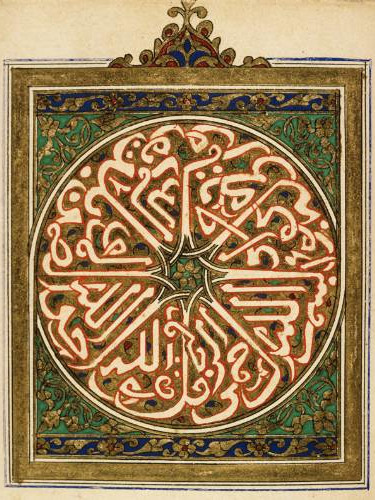
The first Surah, Al-Ikhlas, is one of the shortest yet densest in the Quran. Its name is generally translated as “Sincerity” or “Purity of Faith.” Its core is the affirmation of Tawhid, the absolute Unity of Allah:
Qul huwa Allahu ahad. Allahu-s-samad. “Say: He is Allah, [who is] One. Allah, the Eternal Refuge, the Absolute upon whom all depend.”
The Surah continues by stating that God neither begets nor is begotten, and that there is nothing comparable to Him. The Unity of which it speaks is not a simple numerical unity, but an absolute uniqueness—free from divisions, dependencies, or equals. The term Al-Samad also carries a richness that is difficult to convey in a single word: in traditional interpretations, it denotes the Self-Sufficient One, upon whom everything relies and to whom every creature turns in need.
We can also approach this theological affirmation through a question concerning our inner life: what happens when we lose touch with what is essential?
The mind is often swept by a multiplicity of demands: desires, fears, expectations, judgments, the need for recognition, and the compulsion to conform to an image of ourselves. Attention becomes scattered and fragmented, pulled from one direction to another, until we sometimes confuse who we are with what others expect of us, with what we possess, with the outcomes we achieve, or with how we are perceived.
In meditation, we know this condition well: the fragmentation of attention, the continuous movement of the mind as it shifts from a thought to a memory, from a desire to a worry. What could be simple becomes complicated; what is present is continuously overwritten by what we fear or long for.
In this sense, the contemplation of Al-Ikhlas can become a radical invitation to return to the essential. Not because human consciousness coincides with Divine Unity—a fundamental distinction in the Islamic perspective—but because recognizing an absolute Principle, one not subject to the fluctuations of the world, can help us right-size the power we grant to transitory things.
On a meditative level, we can allow the recitation to guide us in observing our manifold attachments: the need for approval, the anxiety to succeed, the fear of not being enough, and the tendency to constantly seek validation from the outside world. We can ask ourselves what remains when, even if only for a few moments, we stop chasing all of this.
It is not about constructing a new ideal of inner perfection, nor about finding a better self-image to adhere to. Rather, it is about making space. It is about remembering that our worth cannot be surrendered entirely to judgment, success, or the mutability of circumstances.
It is a return to the center—not as a conquest of the ego, but as an opportunity to rediscover a deeper orientation.
Al-Falaq – The dawn, protection, and guarding boundaries
Bismillahir-Rahmanir-Rahim (listen)
1. Qul ‘a’udhu bi-rabbil-falaq
2. Min sharri ma khalaq
3. Wa min sharri ghasiqin ‘idha waqab
4. Wa min sharrin-naffathati fil-‘uqad
5. Wa min sharri hasidin ‘idha hasad
The second Surah, Al-Falaq, opens with a plea for protection:
Qul aʿudhu bi-rabbi-l-falaq. “Say: I seek refuge in the Lord of the daybreak.”
The word Falaq originates from the Arabic root f-l-q, which evokes the idea of cleaving, splitting open, or unfolding. In this context, it refers to the dawn: the moment when the night breaks apart and light begins to manifest.
It is an image that carries within it a promise of transition. Night is not necessarily the final possible state; even when it seems to envelop everything, an opening can emerge—a gateway through which light finds its way back.
The Surah continues by seeking protection from the harm of “that which He created”, from darkness as it gathers, from those who blow on knots, and from envy when it shows itself.
I linger for a moment on this phrase, “from the harm of that which He created” (min sharri ma khalaq), because I find it extraordinary in its apparent paradox. Allah is the Creator of all things. Nothing that God has created is evil in itself. Iron is useful, yet it can become a sword; fire provides warmth, yet it can burn down a house. In Islam, asking for protection “from the harm of that which He created” does not mean that creation is malevolent; rather, it means asking to be preserved from negative side effects or the harm that created things can bring upon us.

From darkness as it gathers. In Islam, everything God creates is Light, Existence, and Goodness. Evil is not a substance created by God with the intention of being evil. “Evil” manifests when a human being, or any creature, moves away from the source of Goodness, creating a shadow zone. Evil is the void left by the absence of love, justice, or spiritual awareness.
From those who blow on knots. The reference to those who blow on knots belongs to the imagery of Islamic tradition and the depiction of harmful magical practices. Symbolically and experientially, however, we can recognize a resonance with those situations in which something seems to hold us back, bind us, or hinder our movement. There are knots that form over time: painful experiences not yet processed, relationships in which we have gradually lost the freedom to be ourselves, ties that continue to exert their weight even when long past. Some manifest in the body as persistent tensions; others return in our thoughts, our automatic reactions, and the way we approach others or navigate life.
The Surah does not propose a psychological theory of these phenomena, but its imagery offers an opportunity for contemplation: identifying what holds us back and orienting ourselves toward the possibility of unbinding and letting go.
The reference to envy likewise opens a reflection on external influences. Within the Islamic tradition, the text retains its spiritual significance as a prayer for protection against harm that can reach a person through the intentions and actions of others. We can align this with an awareness of how deeply our relationships and environments impact our energetic balance.
Devaluing words, constant judgment, manipulation, resentment, and toxic relational dynamics can slowly seep into our self-perception. At times, we end up internalizing the gaze of others, carrying within ourselves judgments that do not belong to us.
In this sense, Al-Falaq can also become an exercise in discerning personal boundaries. Not every influence must be welcomed; not every relationship should have unrestricted access to our inner space. Protecting oneself does not mean closing off from the world, but learning to distinguish what nourishes from what depletes, what helps us grow from what keeps us captive.
In meditation, we can rest upon the image of the dawn splitting open the darkness. We can acknowledge a knot without identifying with it, observe a painful situation without considering it permanent, and imagine that what appears immobile today may one day find a way through.
Seeking refuge in Allah is not a claim to control events. It is an act of trust—the recognition that not everything depends on our willpower, and that we can seek sanctuary even when we are unable to immediately transform the world around us.
An-Nas – The inner whisper and the freedom not to identify
Bismillahir-Rahmanir-Rahim (listen)
1. Qul ‘a’udhu bi-rabbin-nas
2. Malikin-nas
3. ‘Ilahin-nas
4. Min sharril-waswasil-khannas
5. Alladhi yuwaswisu fi sudurin-nas
6. Minal-jinnati wan-nas
With An-Nas, the last of the three Surahs, the movement becomes even more subtle. After contemplating Unity and asking for protection from harm that can reach us from the outside, attention turns toward the insinuations that creep into our inner self.
The Surah opens with the invocation:
Qul aʿudhu bi-rabbi-n-nas. Maliki-n-nas. Ilahi-n-nas.
“Say: I seek refuge in the Lord of mankind, the King of mankind, the God of mankind.”
And it continues by asking for protection from the harm of the waswas al-khannas.

Waswas denotes the insinuating whisper, the subtle suggestion that steals into the soul. Al-Khannas derives from the root kh-n-s, associated with withdrawing, receding, or slinking away. It is an evocative image: something that approaches, whispers, and then retreats, acting without exposing itself openly.
The Surah speaks of that which whispers evil into the breasts of mankind, clarifying that this insinuation can originate both from the jinn (unseen sentient entities) and from human beings.
We know well that incessant chatter that sometimes invades our mind: recurring thoughts, creeping doubts, anxious anticipations, devaluing self-talk, inner voices that seem to know our most vulnerable spots with precise accuracy. It is the rumination that repeatedly draws us back to what has already happened, the anxiety that envisions what might occur, the critical voice that turns every mistake into a final judgment on our worth.
At times, these thoughts are so habitual that they seem to be part of our identity. We no longer recognize them as mental events; we accept them as truth. “I am not capable,” “I won’t make it,” “I am not enough,” “Others will think poorly of me.” The thought does not simply pass through; it becomes a lens through which we interpret ourselves and the world.
Cognitive psychology—and, much earlier in time, contemplative traditions such as Vipassana meditation, Advaita Vedanta, and others—has explored this precise relationship between thought and identification. One of the skills we can cultivate is metacognitive defusion: learning to observe the contents of the mind without automatically identifying with them.
A thought is an event occurring within consciousness, not necessarily a faithful description of reality. We can listen to it, acknowledge its presence, perhaps understand its origin, without having to follow it or turn it into an imperative. It is the difference between saying “I am inadequate” and recognizing “I am having the thought that I am inadequate.” A small linguistic shift that can open up a vast inner space.
In a meditative practice, we can observe a thought as it emerges, develops, and sometimes dissolves. There is no need to fight it, nor to force the mind into stillness. We can simply acknowledge its presence while allowing our attention to return to something more anchored: the breath, the body, the sound of the recitation, or, within the perspective of faith, the presence of Allah and His remembrance.
Here, the dialogue with An-Nas becomes particularly compelling. The Surah does not invite us to rely solely on our own capacity to control the mind; it teaches us to seek sanctuary in the Divine, recognizing our vulnerability and the need for a protection that transcends our ego.
On a meditative level, we can also draw a precious lesson from this: we are not obligated to believe every voice that passes through us. We can learn to discern, to refrain from feeding every whisper, and to avoid handing our identity over to the thoughts that appear in our moments of greatest fragility.
The whisper may be present, but it does not have to rule us.
An inner movement: from Unity to protection, from protection to discernment
The three Surahs, considered together, seem to trace a movement of profound depth.
Al-Ikhlas brings us back to Divine Unity and, in its potential meditative resonance, invites us to rediscover what is essential, beyond the dispersion of desires and expectations.
Al-Falaq teaches us to seek refuge from harm and, on the level of lived experience, calls us to the necessity of guarding our boundaries, recognizing the influences that disturb us, and finding the courage to unbind what holds us back.
An-Nas accompanies us toward the most intimate and subtle dimension: that of thoughts, insinuations, and whispers that can creep into consciousness and draw us away from a freer, clearer perception of ourselves.
We might recognize here three movements of inner practice: re-centering, protecting, discerning.
These are not rigid steps, nor are they a therapeutic sequence. Rather, they are three directions of attention, three possibilities for inward reflection that we can carry with us into meditation and daily life.
And it is perhaps here that the gesture of nafth acquires an even broader resonance. The breath accompanies the word, the word directs the intention, and the hands return the gesture to the body. It is not about exercising an autonomous power over the world or over our inner self, but about letting go of what we cannot govern, asking for protection, and learning, at the same time, to recognize what unfolds within and around us.
Finding the center. Guarding what is fragile. Refusing to identify with every thought.
Three inner movements that can accompany our journey, reminding us that freedom does not arise from controlling everything that passes through us, but from the ability to remain untethered by it.
References and further reading
Sources of the Islamic Tradition
- Sahih al-Bukhari 5017 – The recitation of the three Surahs and blowing onto the hands before sleep
- Sahih al-Bukhari 5735 – Nafth during the illness of the Prophet
- Sahih al-Bukhari 5736 – The recitation of Al-Fatiha and blowing (nafth) in ruqya
- Sahih Muslim 2262 – Guidance following a distressing dream
- Sahih al-Bukhari 3282 – Seeking refuge in Allah during anger
The three Surahs
- Al-Ikhlas – Quran 112
- Al-Falaq – Quran 113
- An-Nas – Quran 114
- Quranic Arabic Corpus – Linguistic and morphological analysis of the Quranic text
- Quran 13:28 (Ar-Ra’d) – The remembrance of Allah and the tranquility of hearts
Breath and scientific research
- Zaccaro A. et al. (2018), How Breath-Control Can Change Your Life: A Systematic Review on Psycho-Physiological Correlates of Slow Breathing, Frontiers in Human Neuroscience. Read the study
- Laborde S. et al. (2022), Effects of voluntary slow breathing on heart rate and heart rate variability: a systematic review and meta-analysis. PubMed
Breath in Yoga
- Patañjali, Yoga Sutra, I.2 and II.49–53: The definition of yoga as the stillness of mental fluctuations and the sutras dedicated to pranayama